SCHOOL NEWS

Martin's Dream Came Alive This Summer
Our Ä¢¹½ÊÓƵ has always represented an effort toward an inclusive community. From the beginning, we have been dedicated to offering an accessible Ä¢¹½ÊÓƵ program and for 17 years our community has worked tirelessly to make our program accessible to anyone who seeks a Ä¢¹½ÊÓƵ Education. More recently, we took up a deeper examination of systemic racism in our habits and the Ä¢¹½ÊÓƵ Movement, and I felt prepared and willing to take up the task of creating a Ä¢¹½ÊÓƵ Anti-Racism Summer Camp.
by Marianne Perchlik
I first felt called to teach to specifically overcome the history of injustice that I observed was impacting everything I cared about. I gradually came to realize this injustice shared one fulcrum: racism.

I chose Ä¢¹½ÊÓƵ Education because I believe we cannot overcome this history without a deeper understanding of the soul and spiritual nature of life and humanity. Arts are tools for developing a healthy soul capable of a thirst for justice, capable of remorse, capable of compassion. Artistic activity accesses courage that can speak to the flow of unconscious, demoralizing, habitual cruelty and builds the capacity for action. A whole human being can speak from an empathetic heart.
Healing History & Called to Action
The wounds of history will need the healing balm of all kinds of practical arts: gardening, culinary arts, weaving, knitting, sewing, as well as drawing and color experiences, and all kinds of visual art, dance, movement theater arts, singing, music, etc. All of these experiences are embedded in Ä¢¹½ÊÓƵ Education for the express purpose of healing and evolving the human soul.
When George Floyd was murdered for everyone to witness I thought that this was a moment when enough people have awakened to the bald truth that the dream of our United States is built upon a forceful, calculated, continuous, cruel history of injustice, a foundation of devastating, relentless abuses and knowing premeditated intentionally cultivated and perpetuated racism.
Our Ä¢¹½ÊÓƵ has always represented an effort toward an inclusive community. From the beginning, we have been dedicated to offering an accessible Ä¢¹½ÊÓƵ program and for 17 years our community has worked tirelessly to make our program accessible to anyone who seeks a Ä¢¹½ÊÓƵ Education.
More recently, we took up a deeper examination of systemic racism in our habits and the Ä¢¹½ÊÓƵ Movement. Last winter as we examined our school, reinforcing our existing Diversity Statement, Land Acknowledgement, and other overt policies, it became clear to me that our gestures were empty without real action.
The Dream Awakens
I felt prepared and willing to take up the task of creating a Ä¢¹½ÊÓƵ Anti-Racism Summer Camp. I had been studying the life of Harriet Tubman for years; a model of compassionate action, defying stereotypes of gender, race and age, dedicated to love and to justice. And I was aware that I could call upon a former colleague to support the camp by offering eurythmy which I believe to be the most curative force in Ä¢¹½ÊÓƵ Education.
In a deep wintery moment, as I contemplated the spirit of Martin Luther King Jr., I could imagine on our beautiful, glorious campuses - campuses we are privileged to inhabit and direct - Martin’s Dream of black and brown children playing and learning alongside white children in joy, happiness and freedom. With the responsiveness of colleagues and interest from families in our community and beyond, we were able to offer two week-long camps; one at the Child’s Garden campus and one on the main campus of Grace Farm.
Our Camp: Intergenerational Conversation & Participation
The camp took up Martin’s Dream. We took up in more detail the early life of Harriet Tubman, whose original name was Araminta (affectionately known as “Minty�). I knew our camp must support parents in growing the capacity to meaningfully engage with students on these matters. This must be an intergenerational conversation.
Each day we took up part of the heroic story of Minty. Preparing a presentation including silk marionettes, verse, eurythmy as well as singing and poetry. Our students and parents created a living representation of the childhood of our heroine.
Of the families who were attracted by the theme, some of those parents actually work in the field of equity and justice. Three of those families had never heard of our organization and were willing to come because they recognized the necessity and importance of the theme.
Children everywhere were already suffering from the limitations of the pandemic, and the increased awareness of Climate Change and racial injustice. And we have known that the rates of anxiety, depression and youth suicide have been escalating rapidly since well before the pandemic. Including parent participation and engagement was essential.
Camp Reflections
The camp included children many of whom were siblings from rising Kindergarteners to 4th grade. The questions and conversations surrounding our preparation were deep and compassionate with a generous amount of nature exploration, active games and free play.
On the last day, I asked the students, “Why have I brought us all together on a beautiful summer day to share in such a sad story?" Immediately a rising 3rd grader answered, “because of Martin’s Dream.� Before I could respond, a rising 4th grader stated, "Because it’s still going on."
At Child's Garden, we had 10 campers and one Mentor in Training; six of these students were Child's Garden alums who now attend public school. The other four participants, and the 13-year-old Mentor in Training, were attracted because of the theme from the larger community.
At Grace Farm we had nine campers also; six were Orchard Valley students, two of whom were newly enrolled having recently moved to the area. One student formerly had attended Early Childhood programming and was now attending public school. Two were from the larger community attracted by the theme.
Campers from Orchard Valley's Early Childhood Summer Program attended the final presentation of the Martin's Dream Camp. We were also able to incorporate culinary arts and gardening activities at the Child’s Garden where students harvested black currants for preserves and helped prepare roasted purple potatoes and multicolored carrots, as well as harvesting snap peas for shared snacks. Sharing different colored foods offered a sensory experience of encountering differences and became a launching pad for noticing more explicitly how we react to encountering differences in something ordinary like sharing food.
Visions for the Future
In 1996, my husband and I were volunteers and we created a Service Exchange for High School students in Middlebury and Rutland areas. We created an MLK Service Celebration offering diversity training, African dinner and dancing, and community service to elders in Rutland. In Middlebury, through the support of the, we offered a student exchange between families from Middlebury High School and Hartford High School in Hartford, CT for long weekends in October in Middlebury and April in Hartford. Participating families offered homestays and we shared in community service efforts in both communities.
I can imagine this kind of summer programming at Orchard Valley in the future after the pandemic ends, where we can share the beauty of our campus with urban children and sow seeds of friendship among children of different races and colors. I can also imagine hosting a similar African meal and dance with diversity training around the celebration of MLK and possibly at the Montpelier Grange.
For next summer, I would very much like to consider offering Martin's Dream Camp again and continuing to work with the theme of Martin's Dream through puppetry, movement, verse and song as we did last summer, possibly including a Gospel Music camp. I would also like to provide scholarships for families of color.
My Journey With Racism & Ä¢¹½ÊÓƵ Education
The privilege of my education demonstrated to me the climate of institutional racism that was the industry standard for all colleges and universities. I noticed, for example, the outright absence of any authors apart from white male authors as an English and Theater major.
“Thankfully, because of one “Women in Literature� course, I had the opportunity to read Toni Morrison at 19 in the late 1980s. In Law School, I studied the civil rights movement case by case. I read the overt, calculated, intentional policies to destroy and dehumanize the native people of the United States. I studied with one of the most prominent professors in the country who was revealing the disproportionate incarceration and execution rate of African Americans at that time in the early 1990s.� I know. I’ve known.
I started teaching at The Initiative; a Vermont Ä¢¹½ÊÓƵ High School that operated on the campus of Goddard College for 4 years. The entire initiative was based on creating an inclusive environment for youth to face and overcome this ruthless history, for the evolution of a humanity capable of stronger loving relationships.
When the Initiative closed I returned to working with new parents, and very young children; work I had done in a private practice of Childbirth Education, Parent Education and Doula Service.
Another reason I began teaching with High School students was because it is what Rudolf Steiner recommended. Working with teens as their soul body bursts into being between the ages of 12 - 21 demands that we face and tame the unresolved burdens of our own soul.
“When children come to the age of puberty, it is necessary to awaken within them an extraordinarily great interest in the world outside of themselves. Through the whole way in which they are educated, they must be led to look out into the world around them and into all its laws, its course, causes and effects, into men's intentions and goals — not only into human beings, but into everything, even into a piece of music, for instance. All this must be brought to them in such a way that it can resound on and on within them — so that questions about nature, about the cosmos and the entire world, about the human soul, questions of history — so that riddles arise in their youthful souls.� - Rudolf Steiner, Education for Adolescents, 1922
(Education for Adolescents, by Rudolf Steiner, was published by the Journal for Anthroposophy in Spring 1979 from excerpts of a lecture given in Stuttgart on June 21, 1922)

Remember when...
Celebrating our 8th graders.
We are so proud of our graduating 8th graders! It is amazing to see how much they have grown since this photo was taken. We sure will miss their shining faces on campus once this school year comes to a close, but they are posed and ready to go forth with the resilience, determination, and passion that we have come to know--and love--them for. Come and celebrate these wonderful young people under the tent on Saturday, June 11th, from 2-4!

Spring Gala!
Our Second Annual Spring Gala and Silent Auction is coming up on May 22nd!
SUNDAY, MAY 22, 5-8PM AT THE VERMONT COLLEGE OF FINE ARTS’ GALLERY, MONTPELIER
Wonderful entertainment, food and drinks are on the menu for this adults-only event. And a fantastic array of Auction items will be filling the tables!
Tickets available online through May 20th, or at the door.

Next Open House: Saturday, April 30th!
OPEN HOUSE ~ Saturday, April 30 ~ 10 am to 12:30 pm
Following on the heels of our wonderful Open House in March, our next one will be April 30. Please help spread the word!
Campus tours and time to ask questions of faculty, staff, and parents.
Children are welcome, with two walks through the fields and forest at 11am and noon and ongoing guided art activities.
- 10:30am – Grades walk-through, including a sample lesson.
- 11:15am - Guided walk
- 11:30am – Early Childhood classroom visits to speak with teachers and parents and learn about our programs, including Farm and Forest, Little Lambs childcare, and Montpelier Child’s Garden.
- 12:00am - Guided walk
Contact Morgan Irons with any questions!
Donate to our Silent Auction!
Our Second Annual Spring Gala and Silent Auction is coming up!
Sunday, May 22, 5-8pm at the Vermont College of Fine Arts’ Gallery, Montpelier
Wonderful entertainment, food and drinks are on the menu for this adults-only event. And a fantastic array of Auction items will be filling the tables!
Donations to our Auction make it the wonderful event it is. You can . Thank you!

10th Annual Pie Breakfast (Saturday, May 7th)!
Join in the fun and visit with friends and neighbors at our delectable Sweet ‘N Savory Pie Breakfast!
8:30am to 12 noon (unless we run out of pie earlier, so be sure to come early!)
Location: Trinity United Methodist Church, 137 Main Street, Montpelier (right next to the Kellogg-Hubbard Library)
$8 per person; $30 per family; children under 5 free
Grade 6 Business Math Block - An Anchor for the Future
Just before February break, Grade 6 completed their Business Math/Economics Block. The class traced the evolution of money from self-sufficiency and bartering to the currency we use today, and delved into percents, their relationship to fractions and decimals, and their role in discounts, taxes, and profits.
They then put this learning right to practical use, as each student designed a business and guessed at the costs of running it. They also learned a bit about how to promote their business by making posters, writing a classified ad, and preparing notes for a radio interview. On the accounting end, each student received a checkbook and register and learned how to use them, and received a ‘monthly salary’ to use to pay all of their bills (mortgage, phone/internet, gas for the car, groceries, etc.). With the money left in their accounts, the students made spending decisions and purchased hypothetical goods from the other businesses - i.e. skirts from the clothing store, a car from the auto dealer (after calculating the monthly payment they could afford), a meal from the café, etc.
Grade 6 Teacher Libby Case remarked that this block was another opportunity “to build a sort of anchor in the students to attach things to. For instance, when we teach Greek history the students don’t delve into all of it, but when they go to college they have something to draw from to build that new learning upon.�
The students wrapped up the block with a Snack Store the last few days before break, using their new skills in a store setting. Snacks were purchased in bulk and a markup was chosen; profits from the sale will be donated to the Orchard School of Montreal. The school visited OVWS last fall and shared that many of the students are quite poor and lack the funds to bring snacks to school, so the school solicits donations from stores to provide this for their students. “We thought that by selling snacks here we could provide them with snacks there,� said Libby Case. As a result of the students’ efforts, they earned $100 that they’ll be sending to Orchard School in Montreal.
When school resumes after break, the 6th Grade will visit VSECU in Montpelier to learn how the credit union works.
Two Summer Programs at Orchard Valley!
Two Summer Programs for 2016!
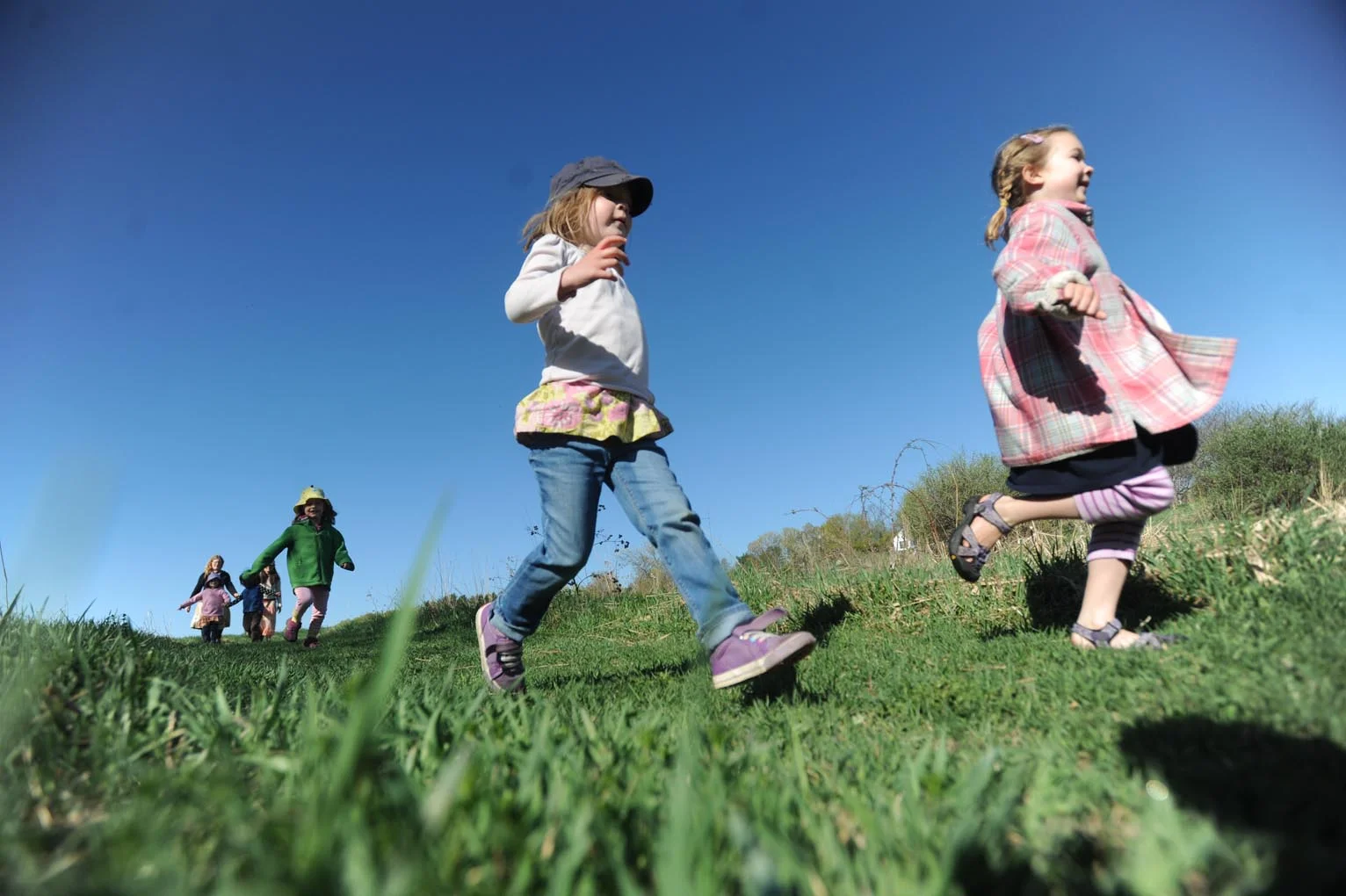
New Farm and Forest Program and Summer Play Days at the Child’s Garden in Montpelier
We’re excited to announce that OVWS will have two summer programs this year:
* Farm and Forest Summer Camp at our East Montpelier campus
* Summer Play Days at the Child’s Garden in Montpelier

Woodworking as a Medium for Self-Discovery
Seated in a circle on the braided rug on the floor in the Maple Tree Kindergarten class, 17 children watch as Heinz works with one child on his woodworking project. The children are making buttons from moosewood (called that because moose love to rub their antlers on these trees – a fact the children love, Heinz says) and they are rapt as they watch the hand drill spinning round, waiting for their turn.
Heinz Rathmann has been teaching woodworking for 21 years now, and this is his fourth year at OVWS. He works with grades 4-8 as well as the Kindergarten. This is the second project for the Kindergarteners; with the first, the children learned how to hit nails into a beautiful round of birch, striking the nails strong and true. Then they wound colorful string around the pattern of nails for a lovely piece that resembles a web.
Heinz says the value of woodworking is similar regardless of the children’s ages. They learn how to move with the tool, something that is as important for the Kindergartener as it is for the 8th grader. When this work is positively expressed, Heinz says, it forms a healthy dance as the work and the movement flow with the tool. They also learn “patience and perseverance, and to strive for the best they can do,� he adds, something that comes forth during the physical act of creating an object.
The seventh graders are working on three-legged stools now during their woodworking guild. They are working with pine, and each stool seat is a work of art unique to the student creating it.
Heinz says that all of the students learn something in the process: Some start with creativity and learn patience; others may start with a greater level of patience and learn to express their creativity through working with the wood. And they always learn about themselves during the process.
For Heinz, that’s the wonderful part. “I love to see them grow and learn about themselves.�

Announcing Our New Outdoor Education Program! OVWS Farm and Forest
Announcing Our New Outdoor Education Program! OVWS Farm and Forest
The orchards and forested landscape of our campus have been a source of inspiration, playful adventure, exploration, and learning for all of us since Orchard Valley began. Now we are proud to launch our first program dedicated to outdoor education, starting in June 2016.
There will be three sessions of theme-based summer camps for children ages 4-11 starting in June and ending in August. In the fall our outdoor program continues for young children ages 4-7 years.
An outdoor classroom during the school year allows children to move, play and discover core principles in science through “hands on� nature-based activities. Children can help build fires, prepare food, find wild edible plants and work in the school gardens as an integral part of the day. Traditional skills in social dynamics and language arts are developed through oral story telling, skits, role-play, puppet shows, games and songs. The themes for each week reflect the wonder of the changing seasons, woodland crafts, folk lore, Native American culture, and knowledge of our local natural environment.
Many Ä¢¹½ÊÓƵ schools in North and South America have been exploring ways to integrate best practices in outdoor and environmental place-based education with traditional Ä¢¹½ÊÓƵ Education. This impulse began decades ago with the European “Forest Kindergartenâ€� model in Copenhagen, Denmark. Forest Kindergartens have recently opened at The Hartsbrook School in Massachucets, the Saratoga Springs Ä¢¹½ÊÓƵ School in New York, and the Ä¢¹½ÊÓƵ School in Carbondale, Denver.
Stay tuned for more details about these new programs in upcoming Apple Core issues. Registration information will also be available soon–contact Morgan Irons, Enrollment Director.
~ Linda Weyerts, Pedagogical Chair